What Is NASH? A Houston Endocrinologist's Guide to Fatty Liver Disease
NASH — nonalcoholic steatohepatitis, recently renamed MASH within the broader MASLD category — is fatty liver disease that has progressed from passive fat accumulation to active inflammation and cellular damage. About one in three adults globally has some form of fatty liver. Most have no symptoms. Many will never progress beyond it. But a meaningful minority will move from fatty liver to NASH, and from NASH toward fibrosis and cirrhosis. The difference matters because the early stages are reversible and the late stages are not. Here's what NASH actually is, how it's detected, and what reverses it.
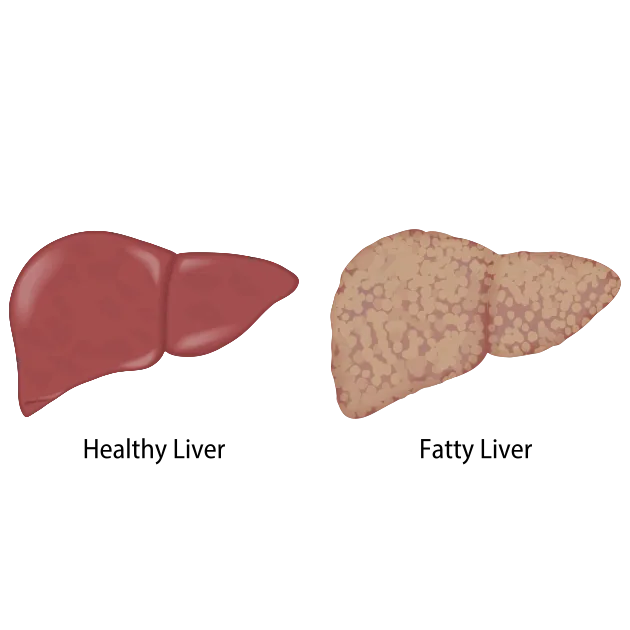
I've spent significant time on this topic in the clinic and on broadcast media — Univision 45 ran a segment with me on fatty liver disease earlier this year:
The conversation in clinic is more specific than what a 12-minute broadcast segment allows, which is why a written explanation matters. Below is the version I run my new patients through when their labs first flag a possible problem.
Table of contents
- What NASH actually is — the clinical definition
- How fatty liver becomes NASH — the mechanism
- What fatty liver symptoms actually look like
- How NASH is detected — the clinical workflow
- NASH vs NAFLD vs MASLD — what the renaming means
- How to prevent or reverse fatty liver — what works
- When to see an endocrinologist — and when to see someone else
- Frequently asked questions
What NASH actually is — the clinical definition
NASH stands for nonalcoholic steatohepatitis. It describes a liver that has moved past simple fat accumulation (steatosis) into active inflammation and cellular damage (steatohepatitis). Three things distinguish it from earlier-stage fatty liver: visible inflammation under microscopy, ballooning of liver cells, and the early signs of fibrosis where scar tissue starts replacing healthy tissue.
In 2023, the major liver-disease societies — AASLD, EASL, and ALEH — issued a multisociety Delphi consensus statement renaming NAFLD to MASLD (Metabolic dysfunction–Associated Steatotic Liver Disease) and NASH to MASH (Metabolic dysfunction–Associated Steatohepatitis). The reason was twofold. First, the "non-alcoholic" framing was clinically misleading — it defined the condition by what it wasn't rather than what it was, which is a metabolic disorder. Second, the old labels were rated stigmatizing by the expert panel — "non-alcoholic" by 61% of respondents and "fatty" by 66% — a barrier to patients engaging with the diagnosis. Most patients I see still encounter both vocabularies. If your doctor uses old or new terminology, both refer to the same condition. I'll use both in this post since search behavior still runs heavily toward "NASH" and "fatty liver."
What stays constant across the renaming: this is a metabolic disorder that affects the liver, not a primary liver disease. That distinction shapes everything about how it should be evaluated and managed.
How fatty liver becomes NASH — the mechanism
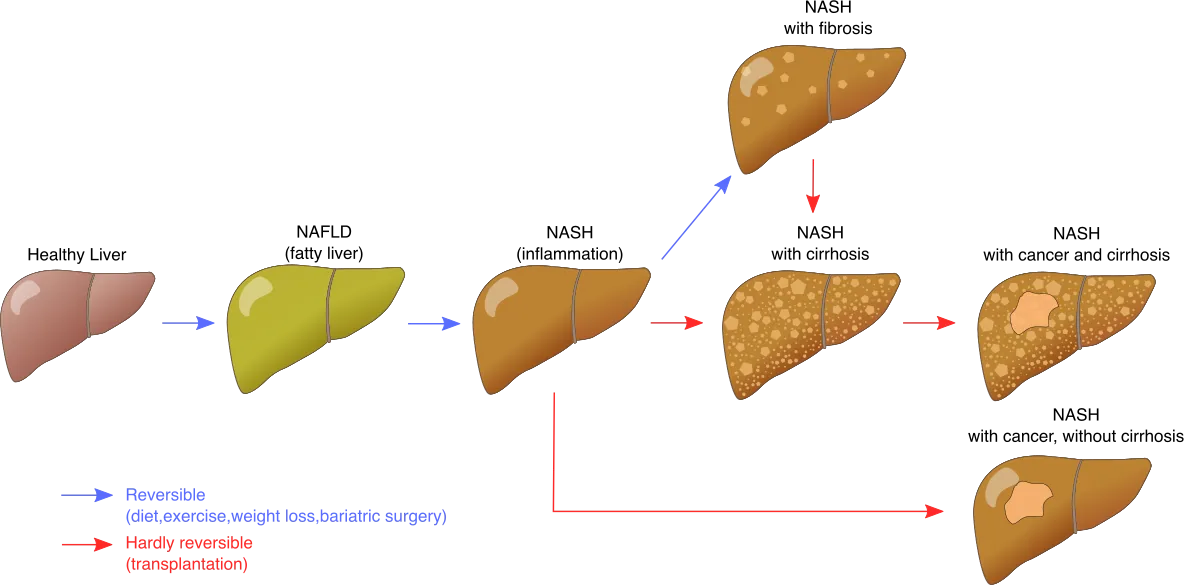
The progression is usually slow and predictable. Insulin resistance — the cellular machinery that should clear sugar from the blood failing to respond properly — drives fat to accumulate in liver cells. At first, the liver tolerates this. Most people with steatosis (simple fatty liver) live with it for years or decades without progression. Some never progress at all.
The shift to NASH happens when the accumulated fat triggers an inflammatory response. The liver cells start showing damage — ballooning, lobular inflammation, fibrosis. From a metabolic standpoint, this is where the condition stops being benign. Once inflammation is established, the liver is actively scarring, and over years that scarring can progress to cirrhosis.
Endocrinology is no longer just thyroid and diabetes. Cardiometabolic disorders and liver health — fatty liver specifically — are the frontier most local endocrinology practices haven't yet expanded into. NASH sits at the intersection of insulin resistance, metabolic syndrome, and liver damage, and the right specialist for early-stage detection and reversal is increasingly the endocrinologist, not the gastroenterologist. The mechanism is metabolic; the treatment is metabolic; the long-term management is metabolic. The fact that the damage shows up in liver tissue doesn't change which specialty actually treats the root cause.
What fatty liver symptoms actually look like
Usually, nothing.
That's the honest answer, and it's the answer most patients are surprised by. NASH and earlier-stage fatty liver are sometimes called silent diseases because they typically produce no symptoms until significant damage has accumulated. When symptoms do appear — fatigue, vague upper-right abdominal discomfort, mild nausea — they're non-specific. Most patients attribute them to stress, sleep, or aging.
Most people I see in clinic arrived because a routine blood test showed elevated liver enzymes. That's good — it caught something early. But the elevated enzymes were almost certainly not the first sign. They were the first sign someone happened to look. Fatty liver had likely been present for years before the lab anomaly registered.
This is part of why the condition is under-diagnosed at a population level. With approximately 30% global prevalence — and prevalence climbing roughly 50% over the past three decades — the gap between people who have fatty liver and people who know they have it is enormous (Younossi et al., Hepatology, 2023). Most discoveries happen during workup for something else: a routine annual physical, an evaluation for unrelated abdominal complaints, imaging done for kidney stones. The condition itself rarely walks a patient through the door.
How NASH is detected — the clinical workflow
Diagnosis happens in stages. Most cases are flagged on routine blood work, then narrowed down through additional labs and imaging, and only rarely confirmed via biopsy.
Standard blood work that flags fatty liver:
- ALT and AST (liver enzymes). Elevated patterns are the most common initial signal.
- Alkaline phosphatase and GGT. Helpful for distinguishing fatty liver from cholestatic patterns.
- Lipid panel, A1c, fasting insulin. Establish whether the metabolic context (insulin resistance, dyslipidemia) is present.
FIB-4 calculation. FIB-4 is a quick calculation from values you already have on your standard lab panel — your age, ALT, AST, and platelet count. It's not a diagnosis, but a low FIB-4 score in someone with elevated liver enzymes can rule out advanced fibrosis with reasonable confidence and avoid the need for a biopsy (AASLD 2023 practice guidance). A high FIB-4 score is the trigger for further imaging or specialist evaluation. The number itself isn't something most patients need to know how to interpret — what matters is that your endocrinologist or hepatologist is running this calculation when the indication is present.
Non-invasive imaging:
- FibroScan / transient elastography. Increasingly first-line. Painless, noninvasive, measures liver stiffness as a proxy for fibrosis. It is available in Houston at hospital-based liver centers — including Houston Methodist, Memorial Hermann and MD Anderson — and at several GI and liver practices; we tell you where your scan will be done when we order it.
- Ultrasound. Detects steatosis well; less useful for staging fibrosis.
- MRI-PDFF (proton density fat fraction). Research-grade quantification of liver fat. Not routine but available when needed.
Liver biopsy. Still the diagnostic gold standard but used sparingly because of invasiveness and cost. Most current workups can stage fatty liver disease without biopsy through the combination above. Biopsy is reserved for cases where the diagnosis is genuinely ambiguous after non-invasive evaluation, or where another liver condition needs to be ruled out.
NASH vs NAFLD vs MASLD — quick terminology map
| Old term | New term (2023+) | What it refers to |
|---|---|---|
| NAFLD | MASLD | Umbrella term — full spectrum from steatosis to advanced fibrosis |
| NASH | MASH | Inflammatory subset where active liver damage is occurring |
There's no clinical urgency to relearn vocabulary. Both old and new terms refer to the same conditions; new terminology dominates clinical documentation and recent research while old terms still dominate patient search.
How to prevent or reverse fatty liver — what works
Weight loss is the foundation. The current EASL–EASD–EASO clinical practice guidelines (2024) recommend specific weight-loss thresholds for specific outcomes:
- Greater than 5% body weight loss reduces total liver fat (steatosis improvement).
- 7 to 10% body weight loss decreases the inflammation that defines NASH/MASH.
- 10% or more body weight loss starts to improve fibrosis (the scarring stage).
Most patients with early-stage fatty liver — before significant fibrosis has developed — see meaningful reversal in the 5 to 10% range. This is why I run a structured weight-management plan as part of the workup, not as an afterthought. The "lose some weight" advice that ends most primary-care visits doesn't translate to the actual clinical thresholds that matter.
Beyond weight loss, several specific levers work:
- Mediterranean-pattern eating is the dietary pattern both major liver societies recommend: it lowers liver fat even without weight loss and adds cardiovascular benefit, and it is easier to sustain than a low-fat diet, which reduces liver fat by a similar amount (EASL–EASD–EASO 2024; AASLD 2023). The mechanism appears to involve a combination of monounsaturated fats, polyphenols, and improved insulin sensitivity.
- Exercise has independent benefit beyond weight loss. Even patients who don't reach the weight-loss threshold often show reduced liver fat with consistent aerobic activity — about 150 minutes a week of brisk walking is the dose the trials used (AASLD 2023; Stine et al., Am J Gastroenterol, 2023).
- Insulin-sensitizing medications when appropriate. Metformin can be part of the picture for patients with concurrent type 2 diabetes or pre-diabetes. GLP-1 agonists have shown specific benefit on NASH/MASH outcomes in recent trials (ESSENCE trial, N Engl J Med, 2025).
- Limiting alcohol even though MASLD is defined by minimal alcohol intake. Alcohol accelerates the same metabolic pathways. The NIDDK and major liver-disease societies recommend limiting or avoiding alcohol once any form of fatty liver is diagnosed.
What does not work as advertised: detoxes, "liver cleanses," milk-thistle supplements, and most over-the-counter fatty-liver formulations. None have evidence to support population-level reversal (AASLD 2023; EASL–EASD–EASO 2024; NCCIH). They're not actively harmful in most cases, but they replace effort that should be going toward the levers above.
When to see an endocrinologist — and when to see someone else
There's a specific patient profile where an endocrinologist is the right specialist for fatty liver concerns:
- You have abnormal liver enzymes flagged on a recent blood test, AND
- You have at least one metabolic risk factor: insulin resistance, type 2 diabetes, pre-diabetes, PCOS, metabolic syndrome, or obesity.
That combination is what makes this an endocrine problem, not a gastroenterology problem. The treatment is metabolic, and the long-term management belongs in the endocrinology lane.
When an endocrinologist is not the right specialist:
- If you already have advanced cirrhosis or active hepatitis, the right specialist is a hepatologist (liver disease specialist). The treatment focus shifts from metabolic reversal to liver-disease management, and that's outside endocrinology's scope.
- If your fatty liver is alcohol-related, the pathway involves addiction medicine and hepatology rather than endocrinology. Alcohol-related liver disease shares some mechanisms with MASLD but the treatment paradigm is different.
- If you have no metabolic risk factors and your liver enzymes are normal, you likely don't need any endocrinology workup — your primary care physician can monitor.
For everyone else in the middle — abnormal labs, metabolic risk, no advanced cirrhosis yet — that's exactly the window where catching fatty liver early and treating the underlying metabolic dysfunction can prevent the progression that leads to advanced liver disease. Two locations: Houston (3100 Edloe St, Suite 210) and Sugar Land (16902 Southwest Fwy Suite 100). Most major insurance accepted.
If you've been told your liver enzymes are elevated and you're not sure who to see next, the answer is usually: see a specialist who treats the metabolic root, not just the liver symptom. That's what we do here.
Frequently asked questions
Can fatty liver be reversed?
Yes, in early stages. In the largest lifestyle study with paired liver biopsies, steatohepatitis resolved in 58 percent of patients who lost at least 5 percent of body weight and in 90 percent of those who lost 10 percent or more (Vilar-Gomez et al., Gastroenterology, 2015). Once cirrhosis develops, reversal is no longer the realistic goal — preventing further progression is.
What are the first signs of fatty liver?
Usually nothing. Most people learn they have fatty liver from a routine blood test or imaging done for an unrelated reason. Vague fatigue and mild upper-right abdominal discomfort can occur but are non-specific and typically not the presenting complaint.
Does fatty liver hurt?
Not in most cases. Some patients describe a dull discomfort in the upper-right abdomen as fatty infiltration progresses, but pain is not a typical presenting symptom and is rarely how the condition is first detected.
Can I drink alcohol with fatty liver?
Limit it. Even though MASLD (formerly non-alcoholic fatty liver disease) is defined by minimal alcohol intake, alcohol accelerates the same metabolic pathways that cause fatty liver progression. The major liver-disease societies recommend limiting or avoiding alcohol once any form of fatty liver is diagnosed.
What blood tests detect NASH?
ALT, AST, alkaline phosphatase, GGT, plus calculated scores like FIB-4. None of these definitively diagnose NASH on their own, but elevated patterns combined with risk factors — insulin resistance, type 2 diabetes, obesity, metabolic syndrome — point toward further workup with imaging or specialist evaluation.
Is NASH the same as cirrhosis?
No. NASH is the inflammation stage; cirrhosis is the late-stage scarring that some NASH patients progress to over years to decades. Most NASH patients never reach cirrhosis if detected and treated. The window for prevention is in the NASH stage, before significant fibrosis has developed.
Does insurance cover fatty liver workup?
Most major insurance plans cover the standard workup — labs, FibroScan, ultrasound — when ordered for clinical concern. Specifics vary by plan and by which specific tests are indicated. We verify coverage as part of intake; if you're unsure, ask the front desk before scheduling.
Book an appointment
If your most recent labs showed elevated liver enzymes and you have any of the metabolic risk factors discussed above, the workup is more straightforward than most patients expect. New patient appointments are at our Houston (3100 Edloe St, Suite 210) and Sugar Land (16902 Southwest Fwy Suite 100) locations. Most major insurance accepted.
About the author
Dr. Andres Splenser, MD, FACE, is a board-certified endocrinologist practicing in Houston and Sugar Land. The practice focuses on diabetes, thyroid, PCOS, weight management, hormonal health, and cardiometabolic disorders including fatty liver disease. Bilingual English-Spanish patient services. More about Dr. Splenser →